
The Importance of Musical Storytelling for Youth
Table of Contents
How Musical Storytelling Shapes Emotional Growth in Youth
Benefits of Music Education for Youth: Beyond the Notes
Why Storytelling, Not Just Music, Drives the Benefit
What the Benefit Looks Like at Different Ages
The Trade-Off Nobody Mentions
Musical Storytelling Activities for Students That Build Empathy
1. Story Swap
2. Character Voice
3. Soundscape Narration
4. Lyric Rewrite
5. Group Ballad
The Debrief Is the Lesson
How to Teach Songwriting to Youth: A Step-by-Step Framework
The Role of Music in Youth Theatre and Performance
Digital-Native Musical Storytelling: Meeting Youth Where They Are
Neurodiversity and Musical Storytelling: Inclusive Practice in Action
Conclusion
Frequently Asked Questions
Last Updated: September 30, 2026
How Musical Storytelling Shapes Emotional Growth in Youth
Musical storytelling pairs narrative with song, rhythm, and performance to help young people process emotion, build empathy, and find their voice. At Theatre of the Rockies, a 501(c)(3) nonprofit arts organization, we have watched it happen: a shy student picks up a guitar, tells a story about losing a friend, and the room goes quiet.
That shift is developmental, not sentimental.
Songs give young people a structure for feelings they cannot yet name: a verse sets the scene, a chorus names the emotion, a bridge offers a turn. When a child learns a sad moment can become a song, they learn hard feelings can be shaped rather than simply endured.
American Psychological Association resources on music and emotion notes that music engages the brain's reward and emotional systems at the same time, which is why a melody can carry a message that a lecture cannot.
Below, we break down how musical storytelling supports emotional growth, what activities work in practice, and how to teach songwriting to youth step by step.
Benefits of Music Education for Youth: Beyond the Notes
The benefits of music education for youth extend past technique. Students learn rhythm, pitch, and performance, but the deeper payoff is emotional regulation, communication skills, and self-efficacy, the belief that effort produces results.
Treating music education as a talent pipeline is a mistake. Most students will not become professional musicians, and that is fine, because the real return is a young person who can sit with a difficult feeling, translate it into a verse, and share it with someone else.
Here is what that looks like in practice:
Emotional regulation: Singing a slow, steady song can calm a racing nervous system.
Communication skills: Lyrics teach students to say what they mean with precision.
Empathy building: Performing another person's story builds perspective-taking.
Cognitive development: Memorizing lyrics and melody strengthens working memory.
Community building: Group singing creates belonging fast.
National Endowment for the Arts research on arts participation has documented connections between arts participation and positive youth outcomes for years. The pattern holds across settings, from school choirs to community theatre.
Why Storytelling, Not Just Music, Drives the Benefit
A useful distinction: music instruction builds skill, while musical storytelling builds meaning. A student who practices scales improves technique; a student who writes a verse about a real event must decide what the moment meant and how to say it so someone else feels it too.
That translation work is where the developmental gains concentrate. Narrative forces sequence, causality, and perspective, the same building blocks students need for reading comprehension, conflict resolution, and self-advocacy.
Practitioners notice a common pattern: students who resist traditional writing assignments will draft pages of lyrics without complaint. A song is allowed to be emotional in a way an essay is not.
What the Benefit Looks Like at Different Ages
The payoff shifts as students grow, and facilitators who ignore that shift get flat results.
Ages 5-8: The win is naming feelings out loud. Simple call-and-response songs with an emotional label ("this is my mad song") build vocabulary for internal states.
Ages 9-12: The win is perspective-taking. Students this age can write from another character's point of view and start to grasp that their version of events is one version.
Ages 13-18: The win is identity and agency. Teenagers use songwriting to test who they are and to say things they cannot say directly to an adult. The song becomes a safe container.
The Trade-Off Nobody Mentions
Storytelling-based music work is slower than skill drills: a teacher can run a rhythm exercise with 30 students in 15 minutes, while a songwriting session may produce one finished verse from a small group in an hour. Programs under pressure to show measurable output sometimes cut the storytelling work first.
The counterargument: the skills that erode fastest without practice are emotional and communicative, not technical. A student who stops playing an instrument keeps the ability to name a feeling and shape it into words, and that capacity travels into every other part of life.
Pro Tip Start with a song students already love. Ask them what story it tells and who is speaking. That single question turns passive listening into active analysis, and it takes about two minutes.
Musical Storytelling Activities for Students That Build Empathy
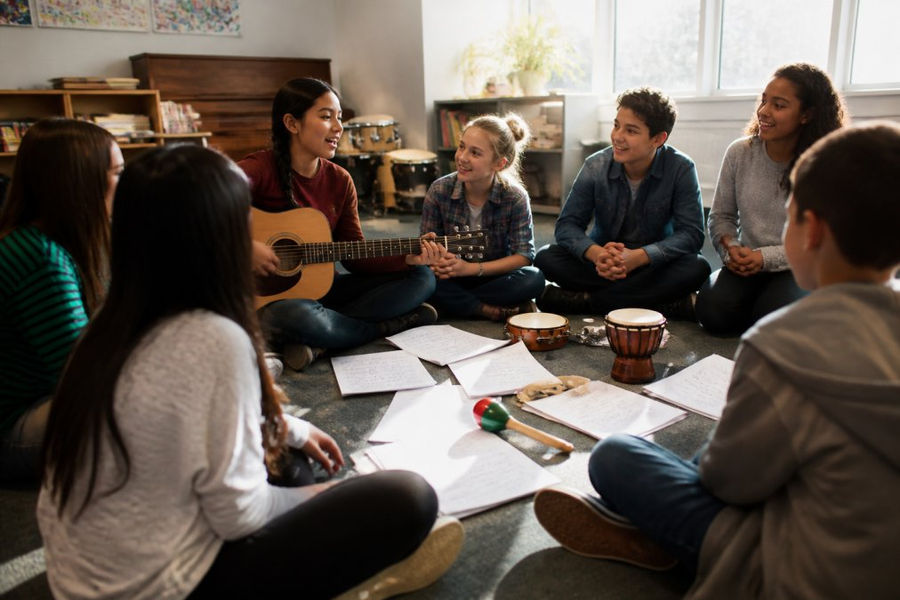
Musical storytelling activities for students work best when they combine listening, discussion, and creation, moving students from consuming stories to telling their own.
Most guides stop at the activity idea and leave out the facilitation that decides whether it lands. Below are five activities with the mechanics that make each work, plus debrief questions that turn a fun exercise into real empathy practice.
1. Story Swap
Setup: Each student brings a song that tells a story and explains whose perspective it uses. Time: 20-30 minutes for a group of 8-12.
Mechanic that matters: Require students to name the narrator, not just the topic. "This song is about a breakup" is a topic; "this song is sung by the person who got left" is a perspective. The second builds empathy.
Age adaptation: Younger students can point to a picture or act out the narrator.
2. Character Voice
Setup: Students write a verse from the point of view of someone unlike themselves. Time: 25-40 minutes.
3. Soundscape Narration
Setup: One student narrates a memory while others add instruments and sound effects. Time: 15-25 minutes.
4. Lyric Rewrite
Setup: Take a familiar song and rewrite the chorus from a different character's angle. Time: 20-30 minutes.
5. Group Ballad
Setup: The class builds one song together, each student contributing a line. Time: 40-60 minutes.
The Debrief Is the Lesson
What most guides miss is the conversation after the music stops. The activity creates the experience. The debrief creates the learning.
Three questions that work across age groups:
What do you think the storyteller was feeling when they wrote this?
What did you notice in the music that told you that?
Whose story did you understand better by the end?
Key Takeaway Empathy does not come from hearing a story. It comes from trying to reconstruct what it was like to live it. Every activity above is designed to push students from listening into that reconstruction.
How to Teach Songwriting to Youth: A Step-by-Step Framework
Teaching songwriting to youth is less about music theory and more about giving structure to self-expression. Most students freeze when told to "write a song." Give them a frame instead.
Total Time: 45-60 minutes Difficulty: Beginner-friendly
What You'll Need:
Paper and pencils
One instrument (guitar, keyboard, or even a phone app)
A list of story prompts
Watch Out Do not correct grammar or rhyme in a first draft. Red-penning a student's emotional disclosure teaches them to hide, not to write. Save mechanics for the second pass.
The Role of Music in Youth Theatre and Performance
Youth theatre turns musical storytelling into a shared, live event. On stage, students do not just sing about a character's grief. They embody it in front of an audience, which raises the stakes and the learning.
Theatrical engagement adds three things a classroom cannot:
Non-verbal communication: Body language and staging carry meaning words alone miss.
Audience awareness: Students learn to read a room and adjust in real time.
Collaborative storytelling: Every performance depends on the whole cast.
Digital-Native Musical Storytelling: Meeting Youth Where They Are
Most young people now build their musical identity online, which is an opportunity, not a problem. Digital-native musical storytelling means using the tools students already reach for: short-form video, loop apps, and collaborative playlists.
A few practical approaches:
Loop-based composition: Apps let students build a full track from a single hummed phrase.
Video storytelling: A 60-second clip forces narrative compression, a useful writing skill.
Playlist narratives: Students sequence songs to tell a story with no words at all.
Neurodiversity and Musical Storytelling: Inclusive Practice in Action
Musical storytelling can be one of the most inclusive practices in the arts, but only if we design it that way. Neurodivergent students often thrive when a lesson offers multiple routes to the same goal: singing, drumming, drawing, or writing.
Offer a non-verbal option, such as instrumental storytelling.
Keep session structure consistent so students know what comes next.
Allow movement, fidget tools, and breaks without requiring justification.
Let students choose whether to perform alone, in a pair, or for the group.
Conclusion
Getting musical storytelling into a young person's life takes a willing adult, a little structure, and the patience to let a first draft be messy. The reward is a student who can name a feeling, shape it into a song, and share it with someone who needed to hear it.
Frequently Asked Questions
Is music a form of storytelling?
Yes. Music uses melody, rhythm, and lyrics to create narrative structure, guiding listeners through tension and resolution. In musical storytelling, a song can introduce characters, set a scene, and convey emotion without a single spoken word. This makes music a universal language for sharing experiences, preserving cultural identity, and building empathy across generations.
What are the benefits of musical storytelling for youth?
Musical storytelling supports cognitive development, literacy, and emotional regulation. It strengthens auditory processing and active listening while giving young people a safe outlet for creative expression. Group activities also build communication skills and community. Research shows that when youth engage in collaborative storytelling through music, they develop greater self-efficacy and a stronger sense of belonging.
How can educators integrate storytelling into music programs?
Start with a simple narrative prompt, like a personal memory or a folk tale, and ask students to compose a short melody or song around it. Use call-and-response to teach narrative structure, or have students create soundscapes for a story they write. Keep it participatory: let youth choose topics that matter to them, and encourage non-verbal communication through instruments and movement.
What is the role of music in youth theatre and performance?
In youth theatre, music deepens emotional engagement and helps actors embody their characters. It can underscore dramatic moments, drive the plot forward, and create a shared emotional experience for the audience. Participatory arts like musical theatre also build confidence and teamwork, as youth learn to synchronize their voices, movements, and timing with others on stage.
VIEW TOUR DATES & TICKETS


Comments